Peer Review Process
Double-Blind Peer Review Policy
The Asian Journal of Information Science and Technology (AJIST) ensure the quality, reliability, and accuracy of the research it publishes through a stringent peer review process. AJIST is committed to maintaining the highest levels of academic rigor and integrity. To promote fairness and neutrality, all submissions to AJIST undergo a double-blind peer review. This document details the principles, procedures, and roles associated with the double-blind peer review process. Each manuscript submitted to the journal is evaluated by at least two independent expert reviewers under a double-blind peer review system before a final editorial decision is made.
Objectives
The double-blind peer review process is designed to:
- Enhance the quality of published research by ensuring that only well-executed and scientifically sound studies are accepted.
- Provide constructive feedback to authors to help them refine and improve their manuscripts, ensuring clarity, accuracy, and completeness.
- Maintain the integrity and credibility of AJIST by upholding high academic and ethical standards.
- Ensure impartiality by eliminating biases related to authors' identities, affiliations, or geographical locations, focusing solely on the merit of the work.
- Encourage scholarly discourse by fostering an environment where reviewers provide objective and balanced evaluations of the research.
- Promote transparency in the review process while safeguarding anonymity and confidentiality to protect the interests of both authors and reviewers.
- Support the academic community by facilitating a rigorous evaluation process that benefits authors, reviewers, and readers alike.
- Facilitate the dissemination of impactful research by selecting studies that contribute meaningful knowledge to their respective fields.
- Identify and address ethical concerns in manuscripts, ensuring compliance with research and publication standards.
- Foster trust in the publication process by providing a fair, transparent, and reliable system for evaluating submissions.
The Double-Blind Peer Review Workflow
The double-blind peer review process is a structured and systematic approach designed to ensure the quality and integrity of the manuscripts published by AJIST. It consists of the following steps:
1. Manuscript Submission
Authors submit their manuscripts through the AJIST online submission system, ensuring all necessary files, such as the manuscript text, figures, and supplementary materials, are uploaded.
2. Initial Screening
- The editorial office conducts a preliminary review to ensure that the manuscript adheres to the journal's submission guidelines, including formatting, word count, and referencing style.
- At this stage, the manuscript is also checked the plagiarism, and to determine whether it fits within the journal's scope and meets basic quality standards. Manuscripts that fail to meet these criteria are desk-rejected, and authors are notified.
- Plagiarism Screening: All manuscripts submitted to AJIST are screened for plagiarism using similarity detection software before they are sent for peer review. Manuscripts with significant similarity to previously published works may be rejected or returned to the authors for clarification. The journal maintains strict policies against plagiarism, duplicate submission, and data fabrication.
3. Reviewer Selection
- The editor identifies two or more qualified reviewers based on their expertise in the manuscript's subject area and their track record as reviewers.
- Reviewers are invited to assess the manuscript and are provided with an anonymized version that conceals the authors' identities and affiliations. This ensures that the review remains unbiased.
- In cases where suitable reviewers decline the invitation, the editor may reach out to additional experts to ensure the manuscript is thoroughly reviewed.
- Reviewers are selected based on their academic expertise, publication record, and research experience in the relevant subject area. Typically, reviewers hold a doctoral degree or possess equivalent research experience and have published scholarly work in reputable peer-reviewed journals indexed in recognized academic databases. Reviewers must also disclose any potential conflicts of interest before accepting a review assignment.
4. Review Process
- Reviewers evaluate the manuscript according to several criteria, including originality, significance, methodology, relevance, presentation, and clarity of writing.
- They prepare detailed feedback, highlighting strengths, identifying weaknesses, and providing constructive suggestions for improvement.
- Reviewers submit their recommendations through the online system, categorizing the manuscript as "accept," "minor revision," "major revision," or "reject."
5. Editorial Decision
- The editor consolidates the reviewers' comments and recommendations, taking into account the feedback provided and their own assessment of the manuscript.
- Based on this information, the editor makes an initial decision on the manuscript’s fate.
- If revisions are required, the authors receive an anonymized version of the reviewers’ comments and are given a specific deadline to submit a revised manuscript addressing the concerns raised.
-
Editorial Responsibilities: The Editor-in-Chief is responsible for overseeing the entire peer review process and making the final decision regarding acceptance or rejection of manuscripts. Associate Editors and Editorial Board Members may assist in selecting reviewers, evaluating reviewer reports, and ensuring that the review process follows the journal’s ethical and editorial standards. Editorial decisions are based solely on academic merit, originality, methodological quality, and relevance to the journal’s scope.
6. Final Decision
- The revised manuscript is resubmitted and may undergo additional rounds of review to ensure that all issues raised during the initial review have been adequately addressed.
- The editor makes a final decision based on the reviewers’ feedback on the revised manuscript, determining whether the manuscript is accepted for publication or rejected.
- Handling Conflicting Reviewer Reports: If reviewers provide conflicting recommendations, the editor may seek additional opinions from a third reviewer or make a decision based on the editorial assessment of the manuscript and the reviewers’ comments. The final decision always rests with the Editor-in-Chief.
7. Publication
- Once a manuscript is accepted, it proceeds to the production stage, where it is copyedited, formatted, and proofread.
- Authors review the final proofs to ensure accuracy before the manuscript is published in the AJIST.
- The published article becomes part of the journal's archive and is made available to readers worldwide.
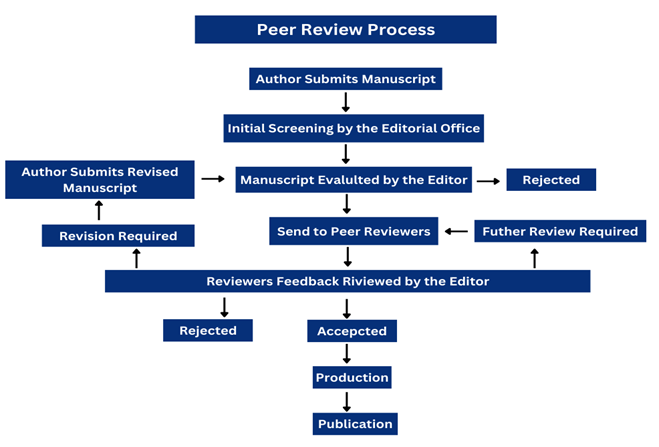
Chart: Double-Blind Peer Review Workflow
This workflow ensures a rigorous, transparent, and objective review process, maintaining the high standards of quality and credibility for which AJIST is known.
Peer Review Timeline
AJIST strives to maintain an efficient and timely review process. The typical timeline for manuscript processing is as follows:
- Initial editorial screening: 1–2 weeks
- External peer review: 4–6 weeks
- Average time to first decision: 6–8 weeks
- Final decision after revision: 2–4 weeks
Appeals Process
Authors who disagree with the editorial decision may submit an appeal, providing a detailed response to the reviewers' comments and justifying why they believe the decision was unjust to the Editor-in-Chief. The Editor-in-Chief considers the appeal fairly and makes a final judgment based on the appeal’s merits and the original peer review process.
For additional information or inquiries regarding the peer review process, please feel free to contact the journal editorial office at editorial@crijournals.org.
When Asked to Review a Manuscript, Consider These Points:
- Expertise Match: Ensure the manuscript aligns with your area of expertise. Only accept if you are well-qualified to evaluate the content.
- Availability: Assess whether you have enough time to review the manuscript thoroughly, typically requiring 4-6 hours. Confirm you can meet the deadline or request an extension if needed.
- Conflicts of Interest: Disclose any potential conflicts that could influence your judgment. Full transparency helps the editor determine your suitability for the review.
Conducting the Review
When conducting a review, maintain confidentiality by not disclosing the manuscript to third parties or contacting the author directly. Your feedback will influence the editor's final decision, so evaluate the manuscript based on the following criteria:
- Title: Does it accurately reflect the main subject or hypothesis, and is it complete?
- Abstract: Does it effectively summarize and reflect the manuscript’s content?
- Keywords: Do they represent the manuscript's focus accurately?
- Background: Is the background, current status, and significance of the study adequately described?
- Methods: Are the methods detailed, sound, and appropriate? Is the statistical analysis valid?
- Results: Are the research objectives met, and does the manuscript adhere to biostatistical requirements?
- Discussion: Is the interpretation of findings clear, logical, and relevant to the literature and clinical practice?
- Illustrations and Tables: Are they clear, well-labeled, and illustrative of the content?
- References: Are recent, relevant, and authoritative references cited appropriately?
- Quality of Manuscript Organization: Is the manuscript well-organized, concise, and grammatically correct?
- Ethics Statements: Are formal ethics documents provided, and does the manuscript meet ethical standards?
Language
If the article contains grammatical errors that hinder understanding, inform the editor but do not correct the language yourself. Suggest minor revisions to the author if necessary.
Previous Research
Check if the article appropriately references previous work and identifies any significant omissions. Ensure references are accurate.
Ethical Issues
- Plagiarism: Report if the manuscript appears to copy substantial parts of other works or lacks proper citation. Request a plagiarism report if needed.
- Fraud: If you suspect data falsification or inaccuracies, discuss your concerns with the editor.
- Other Concerns: For medical research, verify that confidentiality is maintained and that ethical treatment of animal or human subjects is upheld.
Ethical Guidelines for Peer Reviewers
The journal follows the Committee on Publication Ethics (COPE) Code of Conduct and Ethical Guidelines for peer reviewers. We are committed to providing a fair, impartial, and timely review process, with decisions grounded in the manuscript’s significance, originality, and clarity.
Data Integrity and Research Transparency: Authors may be requested to provide supporting research data, methodological details, or additional documentation when necessary to verify the validity and reproducibility of the reported results.
Post-Publication and Accountability
The Centre for Research and Innovation journals adhere to several key policies to ensure post-publication accountability and maintain the integrity of published content. These include the Correction Policy, Retraction Policy, Article Replacement Policy, Expressions of Concern, Article Withdrawal Policy, and Post-Publication Discussions.
View full Post-Publication and Accountability